Think & Discuss
Quick Check
Inquiry Task
Before the replacement, the ultimate source of power was the current year's flow of photosynthesis: fodder grew on farmland, limited by arable area, seasons, and livestock breeding cycles, and the animals themselves consumed large amounts of land output, leaving society with limited disposable net energy. After the replacement, the source of power became a stock of solar energy accumulated underground over geological time, which could be released intensively within a short period without occupying farmland; power could also be deployed continuously, movably, and centrally. What changed, therefore, was not "a more labor-saving tool" but the total amount of callable energy and the way it was called upon. Scoring points: clearly state that the source shifted from biomass flow to fossil stock; note that the constraints shifted from farmland and livestock to mineral deposits, extraction, and transport; explain the differences in power output and deployment.
Possible rebuttals include: the region happened to have easily accessible coal deposits and usable transport conditions; fuel prices and labor costs made steam engines cost-effective; there was stable market demand and capital support; and there was a corresponding accumulation of property rights, laws, and technical know-how. Testing approaches can begin with comparison: examine whether regions with poor coal deposits or expensive fuel also experienced similar power replacements; observe whether the pace of steam engine adoption changed with shifts in fuel prices or transport costs. Scoring points: distinguish observable evidence from inference; do not claim a universal law of inevitability based on one region's experience; acknowledge that the judgment remains an interpretation open to further discussion rather than a proven conclusion.
Learning objective: explain why the Industrial Revolution was essentially a revolution in energy conversion.Understanding the Industrial Revolution as "the textile machine, the steam engine, and the railway being invented one after another" easily misses the thread that truly runs through it: where exactly the energy society used to drive production came from.
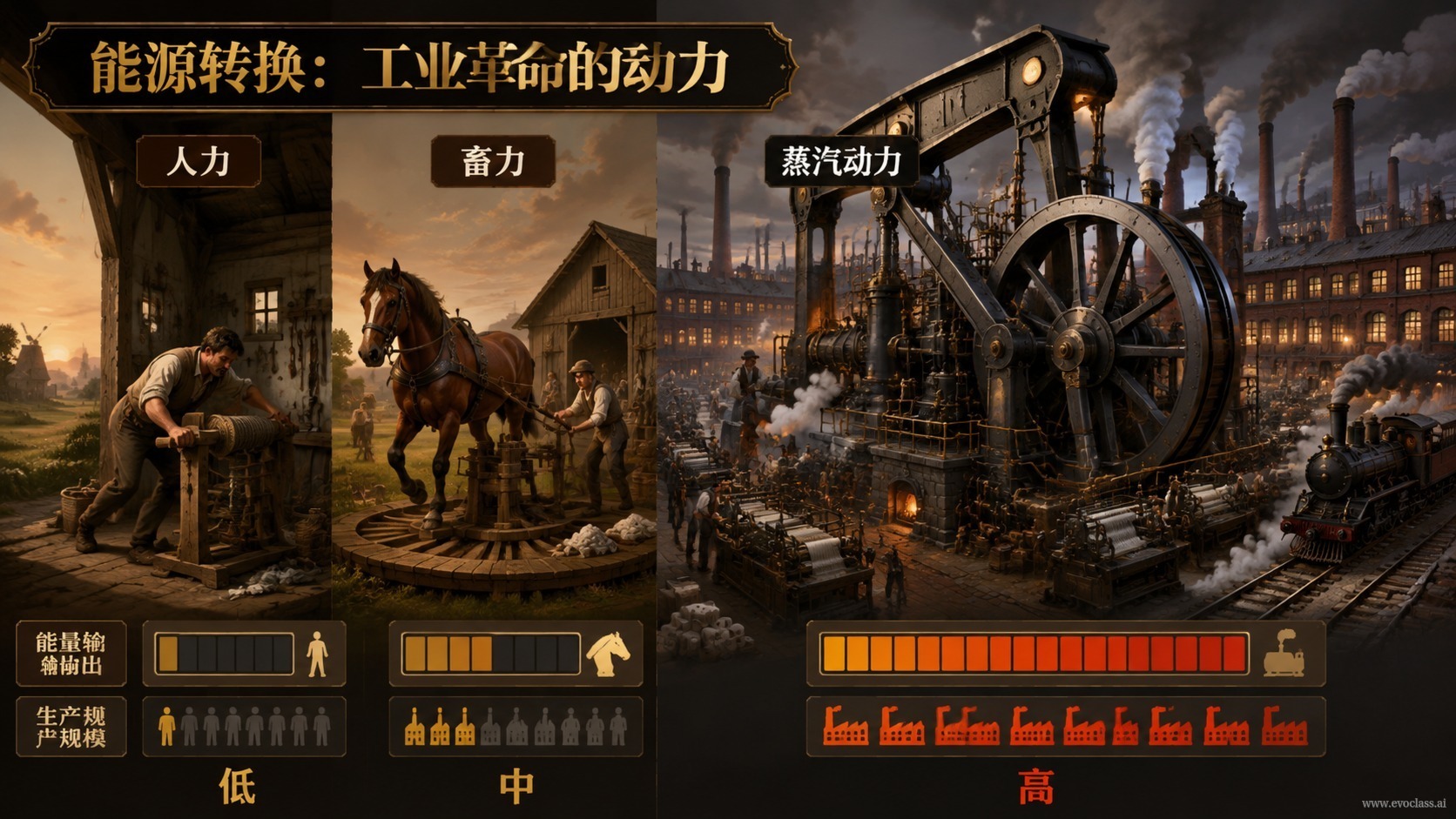
In the pre-industrial era, power came from the flow of energy reaching Earth from the sun in the current year: human muscle and draft animals such as oxen and horses relied on food and fodder produced by photosynthesis, while water wheels and windmills relied on solar-driven water flow and wind. They appear diverse in kind, yet none of them was a fossil stock accumulated over geological time. Sustained human power output was only about 0.05–0.1 kilowatts; draft animals at most several hundred watts; and the animals themselves consumed large amounts of fodder grown on arable land. The net energy society could freely commandnet energywas therefore locked for a long time by arable area, seasons, and livestock breeding cycles, making sustained cumulative growth difficult.
The turning point of the Industrial Revolution lay in this: people began to mine and burn fossil fuels on a large scale, releasing in just a few decades the stock of solar energy deposited over hundreds of millions of years. Once the energy source changed, mechanical power broke free for the first time from the power ceiling of living organisms.
The key breakthrough of the steam engine was converting the chemical energy in coal into continuous, movable, and centrally deployable mechanical power: a single machine could output the equivalent of dozens or even hundreds of horsepower, and it occupied no farmland at all. This turned "flow" into "stock."
| Comparison Dimension | Biological Energy System | Fossil Energy System |
|---|---|---|
| Energy Source | Current year's photosynthetic flow: food, fodder, firewood | Solar energy stock deposited over geological time: coal, petroleum |
| Main Constraints | Arable area, seasons, livestock breeding cycles | Distribution of mineral deposits, extraction and transport capacity, capital and institutional conditions |
| Order of Magnitude of Single-Unit Power | Human power about 0.05–0.1 kW; draft animals at most several hundred watts | A single steam engine could reach dozens to hundreds of horsepower |
| Occupies Farmland? | Yes—the fodder itself consumes land output | No—the fuel is drawn from underground |
| Can It Be Concentrated and Moved? | Limited by terrain, water sources, wind conditions, and livestock scheduling | Power can be moved along with fuel and machinery to wherever it is needed |
The purpose of this comparison table is to ground the abstract phrase "energy conversion" in testable differences: it is not that machines became smarter, but that both the total amount of callable energy and the way it was called upon changed at the same time.
Take mine drainage as an example: early steam engines replaced horse-driven water wheels, and a single machine could take on drainage work that previously required dozens of horses working in shifts—horses that had needed large tracts of farmland to supply fodder. Only when the energy source shifted from "land output" to "underground coal seams" could the scale of mining, metallurgy, and textiles break through simultaneously.
But energy alone does not constitute complete power; it must be combined with raw material development: coal, iron, coke, and steam power formed a mutually reinforcing technology–resource cycle, with mechanized mining, metallurgy, and transport supplying energy to one another.
Changes in agriculture also cooperated during the same period. Before the industrialization of agriculture, most of the food produced on farmland and farms had to be consumed by farmers and draft animals, leaving only a small portion to support artisans, teachers, and officials; farmers therefore made up over 90 percent of the population in almost every society. As agriculture industrialized, fewer and fewer people could feed more and more of the factory and office population—in today's United States, for example, only about 2 percent of the population farms, yet it feeds the entire nation and still has surplus grain for export. It was precisely this large released labor force, absorbed by factories and offices, that truly set the cycle of energy and raw materials in motion; otherwise, no matter how much energy there was, there would be a shortage of people to operate machines and organize production.
As a result, economic growth could for the first time escape the trap of "population–diminishing returns to land": continuously increasing energy inputs supported continuously rising per capita output and provided the material precondition for later industrialized agriculture and the consumer society. When production exceeded demand for the first time, "who will buy these products" became a new question, and the ethic of consumerism entered the scene.
A narrative bias to guard against: describing this transformation as "the inevitable triumph of human intelligence" overlooks its dependence on specific coal deposit conditions, fuel and transport prices, colonial markets, capital accumulation, and institutional arrangements. In a region with poor coal deposits and expensive fuel, the same technology might not have taken hold. Moreover, the energy dividend itself came with ecological destruction and the ethical cost of labor—a judgment that remains open to discussion, not a proven conclusion.
Comparison Chart: Energy Output and Production Scale of Human, Animal, and Steam PowerStudy the comparison chart showing the energy output and production scale of human power, animal power, and steam power, and think about how it relates to "traditional production relied mainly on human power, animal power, and biomass."